Part 1 of a special two part essay for Gandhi Jayanti. Also the fifth essay in my meaning collapse series of which the first is here, second is here, third is here and fourth is here.
If you meet the Buddha on the road, kill him. If you meet the Patriarchs, kill the Patriarchs. If you meet an Arhat, kill the Arhat. If you meet your parents, kill your parents. If you meet your kin, kill your kin. Only then will you attain liberation. ~Linji Lu (The Record of Linji)
There are, broadly, two models of extinction level collapse:
The Cretaceous-Paleogene event (aka asteroid hits the earth) where your existence evaporates soon after the moment of impact.
The Late Ordovician model, where it took a couple of pulses a million plus years apart, but by the end very few species were left alive.
Or if you prefer the collapse of human society, the contrast between the bombing of Hiroshima and Nagasaki versus the disappearance of the Indus Valley civilization over a period of a few hundred years.
As I see it, our current predicament partakes of both: AI gives asteroid vibes, while climate change has more of an Ordivician feel to it. I am not that much of a doomer, for collapse isn’t extinction. Societies have managed to recover, even flourish, after massive disruption.
Semantic collapse is a particular species of collapse. It’s never without physical violence, but the collapse of the lifeworld is more about the collapse of meaning making than about death and destruction. The colonization of the world by European powers was both physical collapse and semantic collapse. In the Western Hemisphere, it was both: much of the native population died as a result of depredation and disease, and the populations that survived have struggled to keep their indigenous knowledge systems alive.
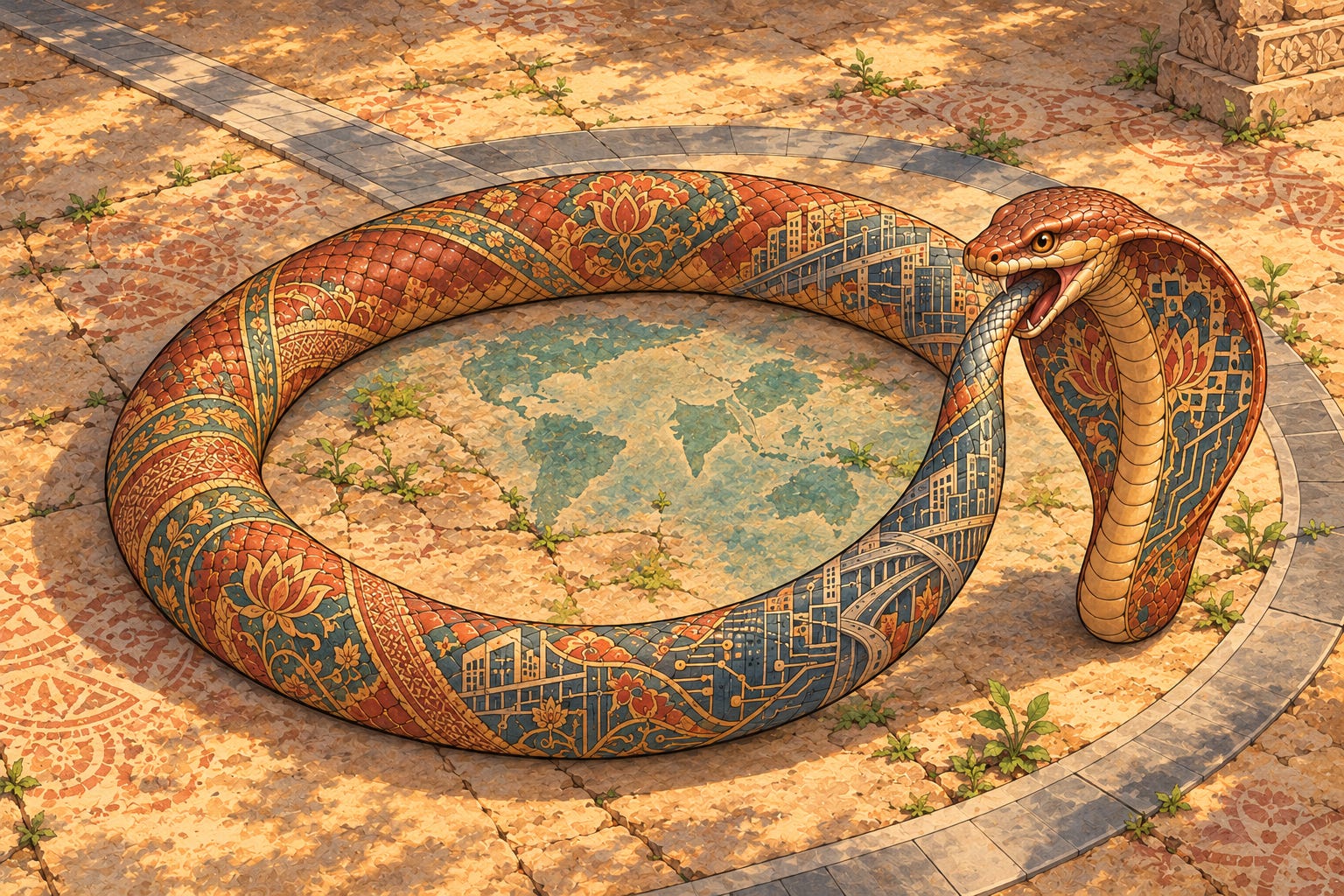
India is a bit different - many people died during the colonial conquest, (and I mean millions: the colonization of India started with the Bengal famine of 1770 where some 10 million lost their lives and ended with the Bengal famine of 1943 where 2-3 million lost their lives) but the longer and wider effect has been the collapse of premodern knowledge systems. We are English in mind and manners, but not entirely so; like the snake that swallowed its own tail, we swallowed modernity as it swallowed us.
At a time when humans as a species are contemplating physical and semantic collapse, the experience of Indians navigating colonial rule might have something to offer to all of us today, and, in particular, a man who was born 157 years ago today is still worth a read.
Happy Birthday, Mohandas!
The Line and the Circle
The dominant western metaphor for modernity is that of progress: we get better and better at science, technology and governance. Even our societies are becoming freer and more liberal every passing day. A couple of world wars might blight the landscape, but the better angels of our nature have been unleashed. Disagree? Think Jesus got it right 2000 years ago and it’s been downhill ever since?
You, sir, are a reactionary.
I much prefer progress to reaction, but there’s an alternative: dialectics, which too has a long European history, but today, I am going to talk about the Gandhian kind, not the Hegelian one.
The Gandhian Contradiction
In my mind, Gandhi held two pairs of contradictory impulses in productive interaction.
The first pair consists of two quintessentially modern ambitions: the nation state and mass politics. Gandhi’s mastery over these two is at the core of his fame. Other Indians of that period retreated into meditation, but Gandhi was one of the pioneers of mass politics, perhaps the greatest practitioner of that art ever. He used several techniques to mobilize people at scale - from publishing newspapers to civil disobedience campaigns, and he steered these campaigns towards the goal of establishing India as an independent nation state.
Remember that in 1915, when he returned to India in 1915, there were barely 50 nation states; today there are about 200. Gandhi’s status as the ‘Father of the Nation’ arises from his command over these modern impulses: the need for freedom, the nation state as the container of that freedom, and the role of mass politics in achieving and maintaining that goal.
But Gandhi didn’t marshall these modern ambitions in a typically modern way, did he? He famously donned a mendicant’s robe, rejecting industrial manufacture for homespun cotton. He rejected modern medicine entirely, and in general, had a strong preference for human-sized production over massive factories. He wasn’t the first person to think that way; William Blake preceded Gandhi by a hundred years, and Gandhi absorbed many of his biases from European figures such as Tolstoy and Ruskin. But Gandhi was the first who managed to turn these heterodox impulses into a civilizational response to modernity. And he did so while rejecting violence altogether; not only was that ridiculed by many, it made Gandhi unique in the roster of famous early 20th century revolutionaries. The English, the French, the Russian and the Chinese revolutions were all bloody; Gandhi made sure that India’s path to independence was relatively bloodless. That too during an incredibly violent period of human history.
The two sides of the ledger: on the modernity side lies nation state and mass politics, on the non-modern side lies spirituality, rejection of machines and violence, and the embracing of tradition. The creative move IMHO lies in championing a modern goal, but then subverting it almost immediately using moral and intellectual resources unavailable to the imperial metropole.
Or to use a more geeky analogy: Lenin was First Foundation, Gandhi was Second Foundation.
What are the lessons for us today?
Gandhi matters more than you think, and less than you think (dialectics ftw).
Let’s start with less: both the nation state and mass politics are tired ambitions, hindrances to a flourishing future. The return to tradition has been thoroughly discredited by the rise of fundamentalism, and the rejection of industrial manufacture in favor of hand-made craft is a non-starter.
Now for the more: if he had been active today, Gandhi would have seen the Planet clearly as the political object par excellence, but to see it even half as clearly as he would have, we have to kill him first.
The dialectic of less and more to be continued in part 2