Kind of a sequel to my earlier essay on shutting up and proving.
Tanha
About a month ago, I started waking up between 4:00 AM and 5:00 AM every morning. Doesn’t matter when I go to bed; whether I am asleep exhausted at nine, or binge watching Ted Lasso until midnight, the internal alarm goes off no later than 4:45 AM. Now, this isn’t a dramatic development, for I have been waking up between 5:00 and 6:00 AM for years, but the alarm going off an hour closer to midnight is a sign.
Of what?
Could just be me growing older. It’s said that the older you are, the poorer your sleep. I bet that’s a partial explanation, but there’s more to it than the passing of years, because I haven’t been able to shake off the feeling this entire summer that we are living in the end times. Not in the Christian sense of an apocalypse - though that too is possible; people working at Anthropic are publicly declaring that AI has a 10% chance of ending all human life before 2030 - but in the sense that what’s coming in the next few decades (or is it the next few years? next few months? next few weeks? hard to tell how fast the clock is ticking) will negate all of human history and usher a new era.
The monster ringing in this new era keeps changing names; these days he goes by ‘AI,’ not too long ago, he was called ‘Climate Change’ and tomorrow he may go by some other label. I fear I have been inviting this monster into my dreams. Come to think of it, my obsession with climate change set my body clock back by an hour. AI has subtracted another hour.
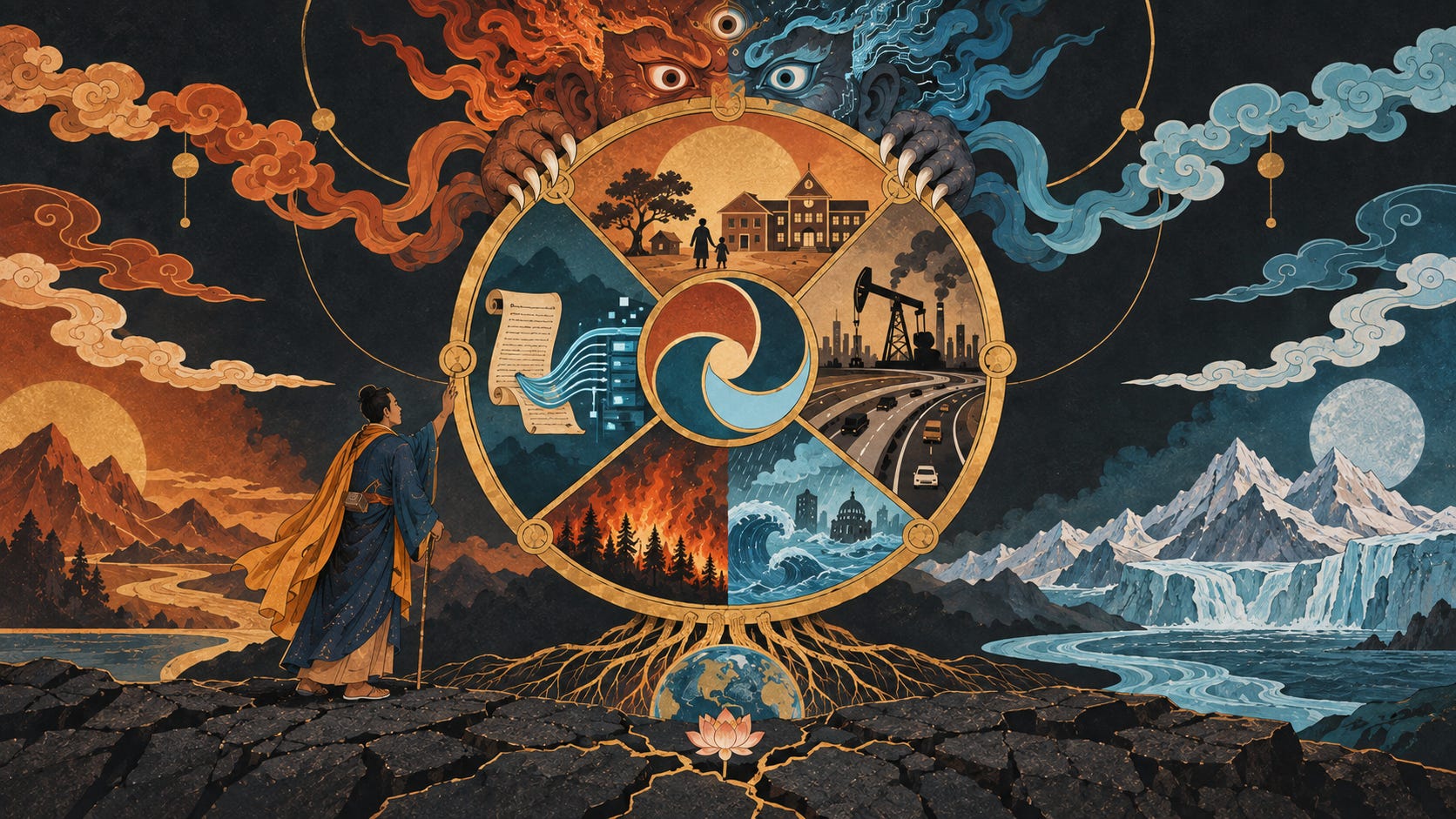
Buddhists talk about tanha, the craving for sensual pleasure and for continued existence. That, according to Buddhist doctrine, leads to rebirth and the cycle of suffering, continued from one existence to another. It’s traditionally attributed to individuals, but we can generalize the term to a civilizational setting, or even to the species level. Perhaps humans are experiencing collective tanha because we want this civilizational life to go on (while clashing with other civilizations, if you believe the Huntington thesis). Civilization is an anthropocentric project in which our dominance over the planet is taken for granted, even celebrated.
Whether it is AI or climate change, our collective tanha is in an acute state of crisis because we know business as usual cannot continue. Everything that is solid is melting, and some of it will go up in flames. That’s as true of the built environment that we have created as it is of the knowledge traditions and knowledge environments we’ve created. No wonder there’s mathematician’s tanha and the oil corporation’s tanha.
Here’s a thought: at their root, they’re not that different.
Forget that Buddhists have a very specific ontology of how tanha unfolds in our lives. Instead, stay with the larger, profound, insight that we carry the realization of impermanence wherever we go, a realization that on the one hand filters into our experience where it’s felt as a basket of emotions (fear, desire etc), and simultaneously, the realization spreads out into the world, far beyond individual human existence. For our current purposes, that realization of impermanence encompasses our social institutions and cultural traditions, and arguably the planet as a whole.
This realization of civilizational impermanence and the crisis that it provokes is what I’m calling tanha.
Back to Mathematics
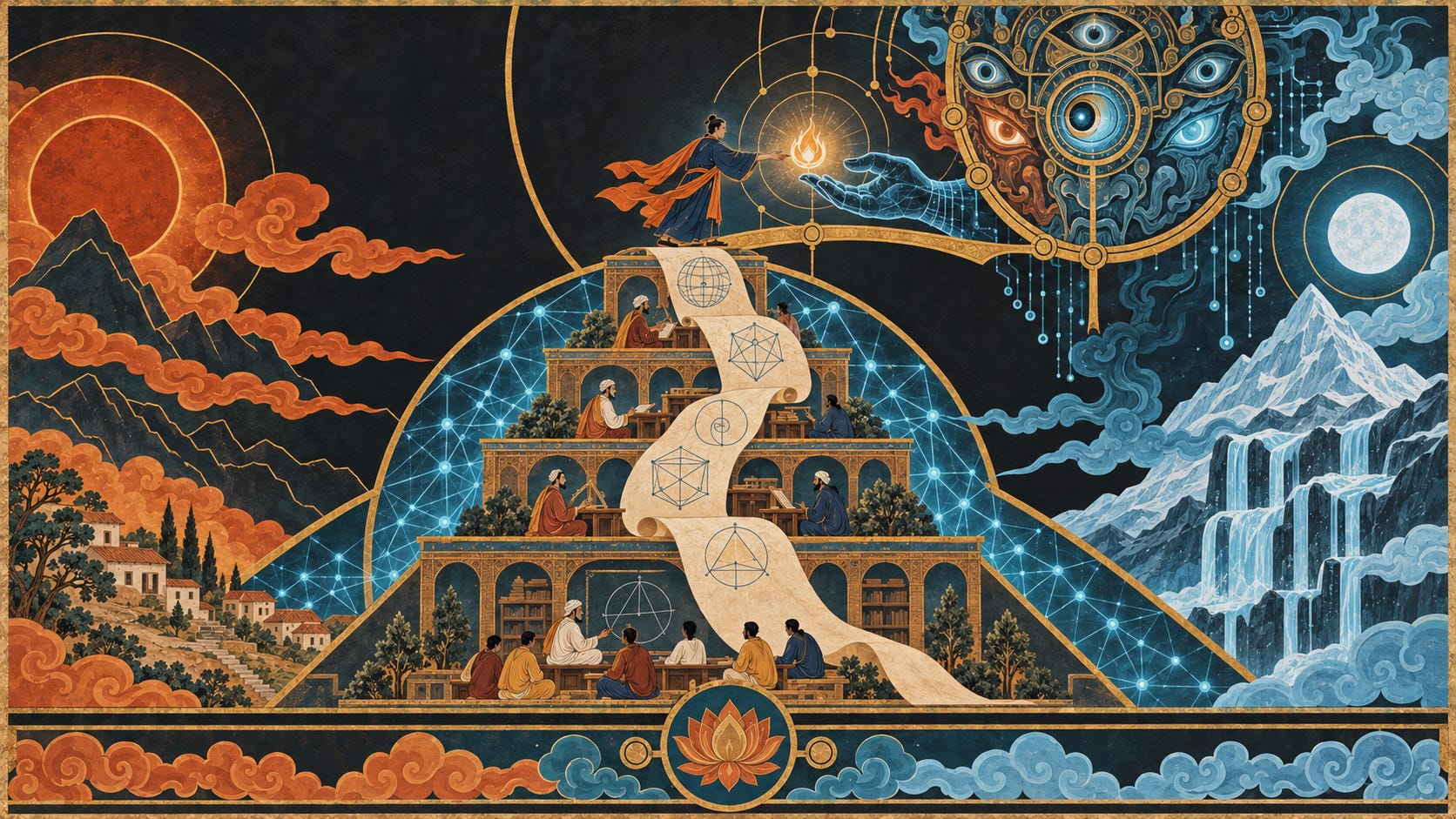
People have been claiming for a while that AI is going to decimate the professions. Radiologists, lawyers, accountants, illustrators, and writers have all been singled out as prime targets. But the first domino to fall is an unexpected one: mathematics. The reasons are clear in retrospect. Mathematics has a huge written corpus that the frontier labs have ingested. Mathematics has explicit metrics for success: a proof is a proof is a proof, and not only that, we have good tools for verifying claims of success. With frameworks like Lean, verification is built into the automation cycle.
And that’s just on the technical side.
On the human side, mathematicians perform a relatively narrow range of functions. Algebra and Calculus classes across the world are a lot more like one another than writing classes are. I can be trained in mathematics in China, step off a plane and start taking graduate classes in Boston tomorrow or be immediately useful to a startup in San Francisco. Try doing that with creative writing. The universality of mathematics means the entire edifice from its highest reaches in research on the Langlands Program to Community College algebra courses (or even middle school algebra) are:
Experienced by professionals as belonging to the same communal enterprise.
Math professionals are distributed across the world; they are in every region, and if you include school teachers, in every village.
There’s a lot of prestige associated with being in the profession - the apex of the pyramid consists of humans considered the smartest people alive, and even in its lower reaches, you’re considered smart if not well paid.
Taking out the top guys of the profession sends shock waves throughout the pyramid.
If you add it all up, Math is a pretty compelling target for the new apex predators. In contrast, a profession like the law has a lot more variable and contextual human judgment built into it. Maybe that’s just my take, but I’m willing to die on that hill. None of this is to say that OpenAI or Anthropic proving the millennium problems will end mathematics as it is, or that somehow proof will replace insight. People are people, and they want understanding. But as I said in my previous essay, we spent the last 60, 70 years in the “shut up and prove” mindset, and that has to go away before understanding gathers prestige.
A Reasonable Medium
I also have a Tanha-ish take on these developments, which starts with the recognition that mathematics occupies the commanding heights of symbolic representation.
Of reason expressed in writing.
Writing (or even more generally, inscription on paper) has many purposes, with reasoning on parchment being one its key use cases. Accountants do it, architects do it, and so do mathematicians. In fact, mathematics is a high point of that craft (note I didn’t say ‘highest’), that has been refined over a couple of millennia from calculational procedures of various kinds to the highly abstract and general system of axioms and lemmas and proofs. AI is revealing the unstable ground beneath the feet of the theorem prover, but IMHO the deeper crisis here is not that of mathematics alone, but of reasoning grounded in 2D symbols more generally. Consider how it’s common to say Neural Networks aren’t interpretable - well, that’s true, but only to the extent interpretability (an inherently hermeneutic act, if I may say so) is itself about reducing understanding to symbols on paper. Perhaps the problem lies in the inadequacy of the medium of interpretation, not in the object being interpreted.
Hypothesis: we are at the cusp of a profound shift in the medium of reason itself.
And unless we grasp that such a shift is underway and the tanha generated by that shift, the sudden revelation of impermanence in the most solid knowledge substance there is, we will not achieve a deep enough understanding of what is afoot. Having said that, this is an intricate set of concerns and:
This is a mere glimpse into the unfolding of form, and my grasp, such as it is, is aesthetic, not epistemic. To put it in simpler terms: I am sharing my intuitions, not my knowledge.
Because my grasp is tenuous, it could be totally wrong. I don’t think it is, but it could be.
(Un)Fortunately, the tanha of our civilization isn’t restricted to AI solving millennium problems.
9/11
9/11/2001 was a gorgeous September morning. Bright sunshine, blue skies, not a cloud in sight, warm but not hot. I was already in my lab, and my wife was at work. My parents were visiting from India. I was talking to my wife on the phone when she got a call from her sister, saying a plane had crashed into the World Trade Center.
That itself was shocking, but while we were talking about the first event, a second plane crashed into the other tower. Every hour revealed yet another hijack: the Pentagon, a plane crashing into the fields, who knows what else?
The rest of the day was a blur. My brother had just joined graduate school in New York. His apartment was on 56th and Lex, far away from the World Trade Center, so we weren’t too too worried, but still, we didn’t know if he was OK. All our attempts to contact him failed. It was mid-afternoon by the time I was able to call him. He hadn’t left his dorm yet, or turned on the TV (why would he - it was morning!) and had no clue what had happened.
Others weren’t so lucky. I had been talking to Tom Leighton, the MIT prof and one of the founders of Akamai, about my work on small world networks. Tom had even loaned me one of his books. His student, also a founder of Akamai, was on the Boston plane that crashed into the WTC. The only person I knew who died that day.
How the world changed in a few hours!
Until September 10th, it looked like the end of history had arrived, that the United States had won, and liberal democracy combined with market capitalism was the politico-economic system of the foreseeable future. 9/11 changed all of that. I still don’t understand why the forever wars happened. Why did the United States invade Afghanistan? Why not just go in, take out a few people, and get out? And then the invasion of Iraq. Like, why? Why do this? I understand the anger from the attack on the US, but why this impulse for overwhelming revenge? We saw that after October 7, 2023, too, one that has turned into genocide. Or, closer to 9/11, the brutal riots after the burning of the train in Godhra.
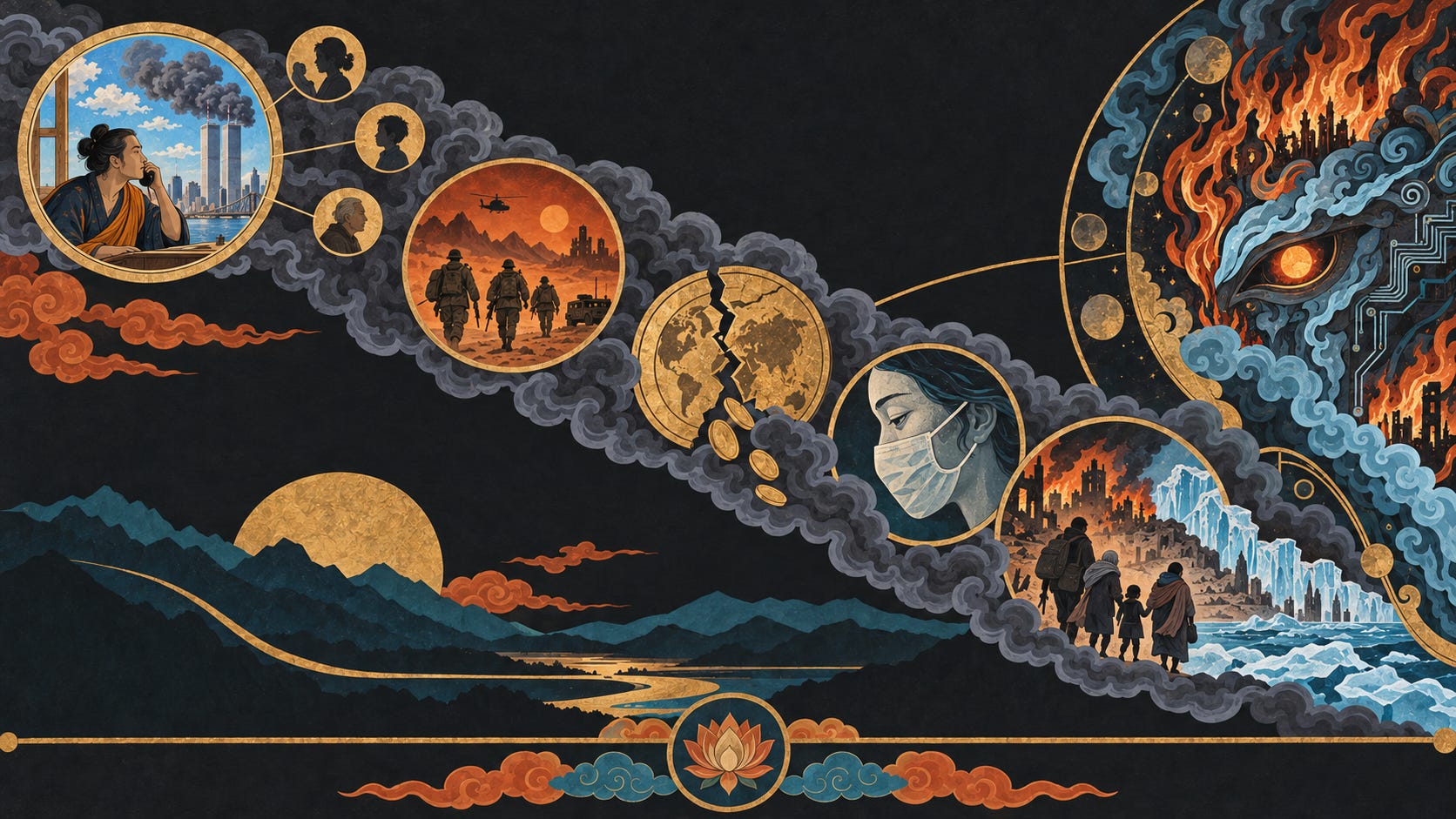
There’s something about this modern system which claims to be far more nonviolent than regimes past. It probably is. People do live longer, better lives. But when things go wrong, they go outrageously wrong. And 9/11 was one of those days. It revealed a fault line in the global system that has only deepened over the last 25 years. I’m going to give a brief timeline. First came 9/11. Then the invasion of Iraq. Then the financial crisis of 2008. Then the election of Trump. And then COVID, then Russia’s invasion of Ukraine and Israel’s genocide of Gaza. And our deepening understanding of how climate change is going to totally fuck us up. Except when forests burn or glaciers break and kill thousands: then it’s in the foreground.
But even that feels a little dated.
The Time of Monsters
With AI, you have a technology that came out of nowhere. I mean, it was known in academic labs and a few Valley companies, but normies didn’t know about it until a few years ago. Besides proving theorems that no one has proven before, people are resigning from frontier labs because they think this technology can kill all of humanity by 2030. Yes, some of these beliefs might be outrageous and unbelievable and might be masking other impulses, but how did we go from the end of history to the end of days in 25 years?
That’s what I want to understand. That is our tanha.
We thought this system was stable and functional, unequal for sure, but going in a positive direction. It’s actually a system that is living off of debt. Economic debt, social debt, but most importantly, debt to the non-human natural world. And behind it all is temporal debt, a debt to deep time that Marcia Bjornerud writes about. I’m not saying this system is going to collapse; that’s an apocalyptic vision with Christian undertones that isn’t my cultural archetype. But this system is going to have to radically transform itself; it’s going to have to become planetary. I don’t know exactly how that’s going to happen, or if it’s going to. Much of the tanha we are experiencing is because the old system is dying, but the new system isn’t visible yet.
Which is to say, it’s the time of monsters. I wrote this at the beginning of 2025, the day Trump resumed office:
We live in a world in the midst of profound transition. The end of history’s faith in liberal democracy has crumbled, replaced by an illiberal global capitalism, sinking “liberalism as culture” alongside “liberalism as power.” With the collapse of the liberal Leviathan, a new possibility emerges: Bhumics, conceived as a planetary framework superseding politics and economics.
Drawing on Gramsci’s concept of an interregnum—a time when the old order is dying but the new one remains unborn—I want to explore the shift from hope to fear as the ruling emotion of our age. The “time of monsters” is upon us, when new hegemonies are yet to arise. I believe the next monster will be planetary in scale, shaped by climate crises, shifting demographics, etc.
No mention of AI in the last line of the quote, which was an oversight. No mention of 9/11 either, the day when the monster was first sighted. Like Sauron rebuilding his powers as the Necromancer in Mirkwood, the monster has been creeping into our world bit by bit. It’s clear to me that whether you are a mathematician or a politician, the monster has something to say to you. And about you.
The good thing about AI is that it’s both a monster (or rather, one facet of the monster) and its powers make the rest of the monster more visible. If you prompt it well.
PS: since the monster’s face was political last year, I ended up using Machiavelli’s Prince as a guide to the new world; by now the malaise has become more generalized, striking at the core of intellectual life. What should I read now? Lakatos? Zalamea? Both?